A language for agents
Small, typed, and limited to the tools you approved, discovered in a REPL rather than listed in the prompt.
 PtcRunner
A runtime for building self-improving agents
Bound execution, inspect failures, verify outcomes, and test changes before adopting them.
Small, typed, and limited to the tools you approved, discovered in a REPL rather than listed in the prompt.
Built for bounded, traceable jobs and many concurrent requests, without a desktop, workspace, or container for every agent.
Three runnable examples
Process 138,236 payment records within a bounded mission heap. Correct a mismatch, or withhold an answer that cannot be checked.
View source on GitHub → Mix model + rules Support triageCombine model flexibility with fixed business rules and separately granted tools.
View source on GitHub → Repair from evidence Adaptive web parserRepair a stale parser, verify it on a page the model did not see, then reuse it without another model call.
View source on GitHub →One demo pattern
This example uses one workflow and three mission environments to show code evaluation and permissions. Each environment gets different code, data, and tools. It is one of many patterns you can build with the same runtime.
First run repair and verify
accepted.cljIt is missing.candidate.cljThe candidate is real PTC-Lisp, not trusted host code.accepted.clj.Outcomes drive the workflow. Each evaluation returns a value or a bounded failure. The workflow can inspect that outcome, evaluate another program, retry, compare results, or adopt a candidate. The full trace is recorded separately; reading it inside a workflow requires an explicit capability.
Next runaccepted.clj → browser mission → result
No model call.
Why not a coding agent?
An agent's results come from the model and the harness around it. Coding agents have the strongest harnesses today, so people use them for many non-coding jobs too.
But a service has different needs. It must handle many requests, stop one run from using too much time or memory, and explain later why it made a choice.
PtcRunner makes those runtime features: fixed limits on time, memory, and tool calls;
a structured trace from every run; and thousands of isolated runs on one machine. Run
workflows with ptc run, then inspect their traces from another authorized
PTC-Lisp program, the REPL, or the Viewer.
Change the agent, not its authority
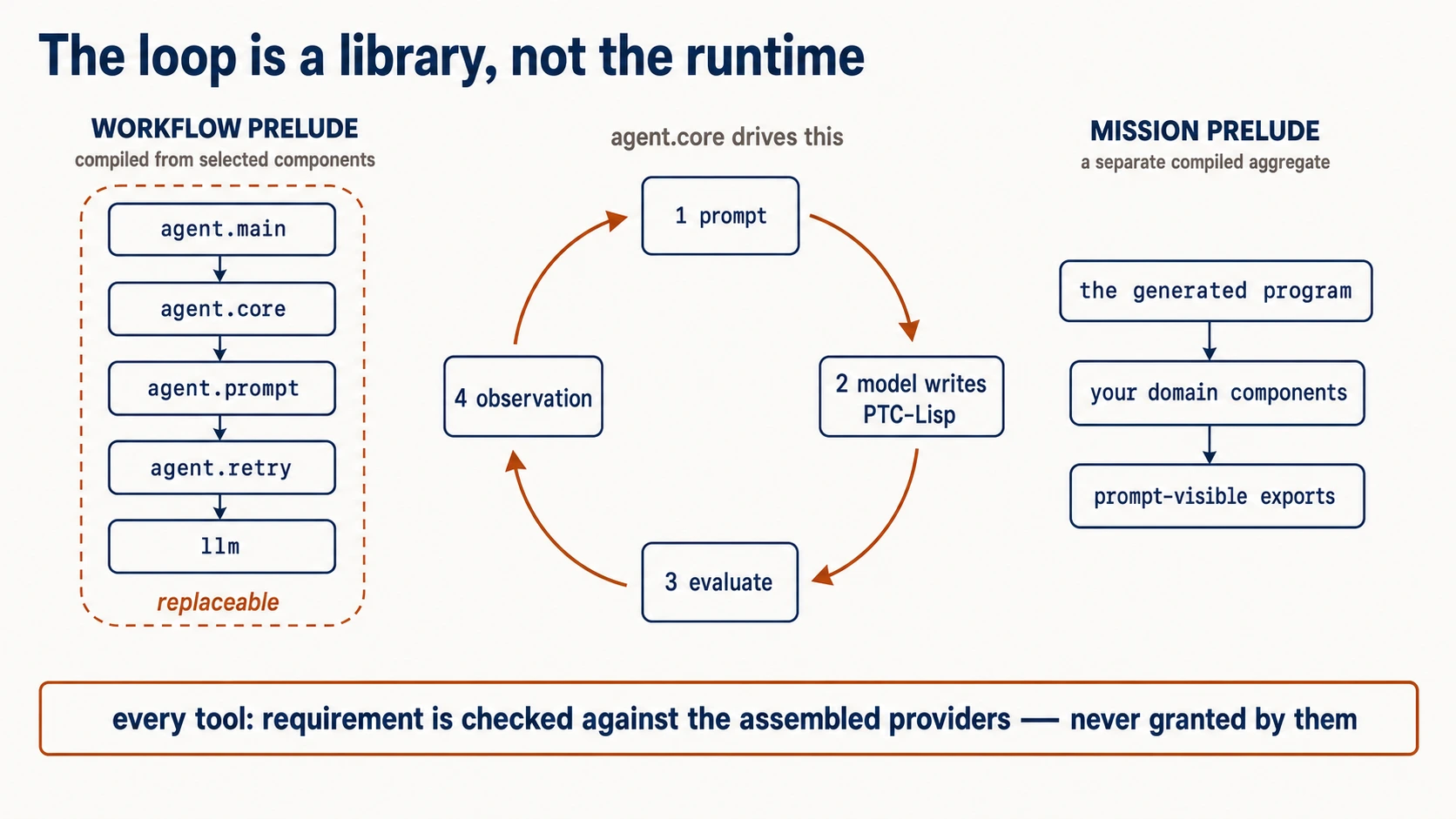
A system that improves itself must be able to change itself. In many frameworks, the agent loop is trusted host code. Changing the loop can also change what the agent may do.
Here the loop is an ordinary PTC-Lisp library. You can replace how the agent works without giving it more tools. Replay holds the model fixed, so you can test a candidate against the old version before a person decides whether it ships.
Runtime guarantees
No import, open, fetch, or shell. A sandbox
takes a language that can do anything and removes the dangerous parts one by one. Here
there is nothing to remove: a program can use its input and the tools you approved, and
nothing else.
Components and tools carry signatures. Inputs are validated before a call runs and outputs after it returns, so a value of the wrong shape stops at the boundary instead of flowing on.
Inputs, tool calls, evaluations, outcomes, and limits become structured evidence you can inspect and test.
ptc-host.json installs providers and sets outer limits.
ptc.json selects from them and may make the limits tighter for one project.
Will the model write it?
PTC-Lisp is a bounded, Clojure-like language with types checked on input and output. The model writes one short program per turn instead of a long chain of tool calls, the pattern often called code mode, against tool signatures it can explore in a REPL.
The tutorials use a small, low-cost model by default. Try it on your tasks and measure the result.
Take the language tour →Improve from evidence
Evidence is used at two different times. During a run, the DABStep example makes two analyses and a reviewer agree before the workflow returns an answer. After a run, the repair example reads the failure's trace, proposes a change, and tests it on inputs the model did not see.
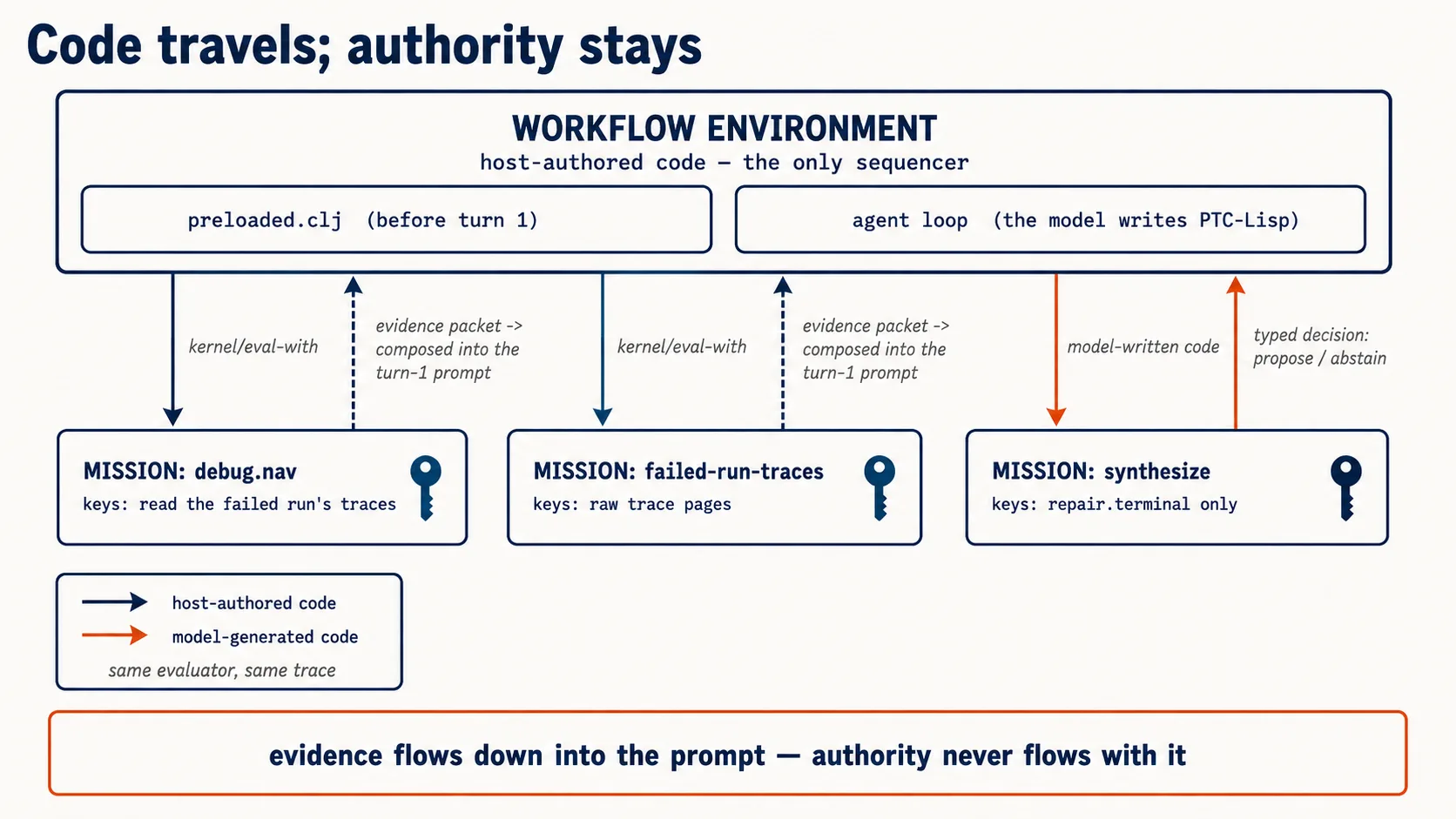
A repair run is an ordinary run too. It leaves a trace, so the debugger can be tested and improved with the same tools it uses on everything else.
Optional local viewer
The runtime records structured traces without needing a UI. The included Viewer is a convenient way to explore one: see the result, limits, tool calls, model sessions, and errors in one place.
Open the Viewer reference →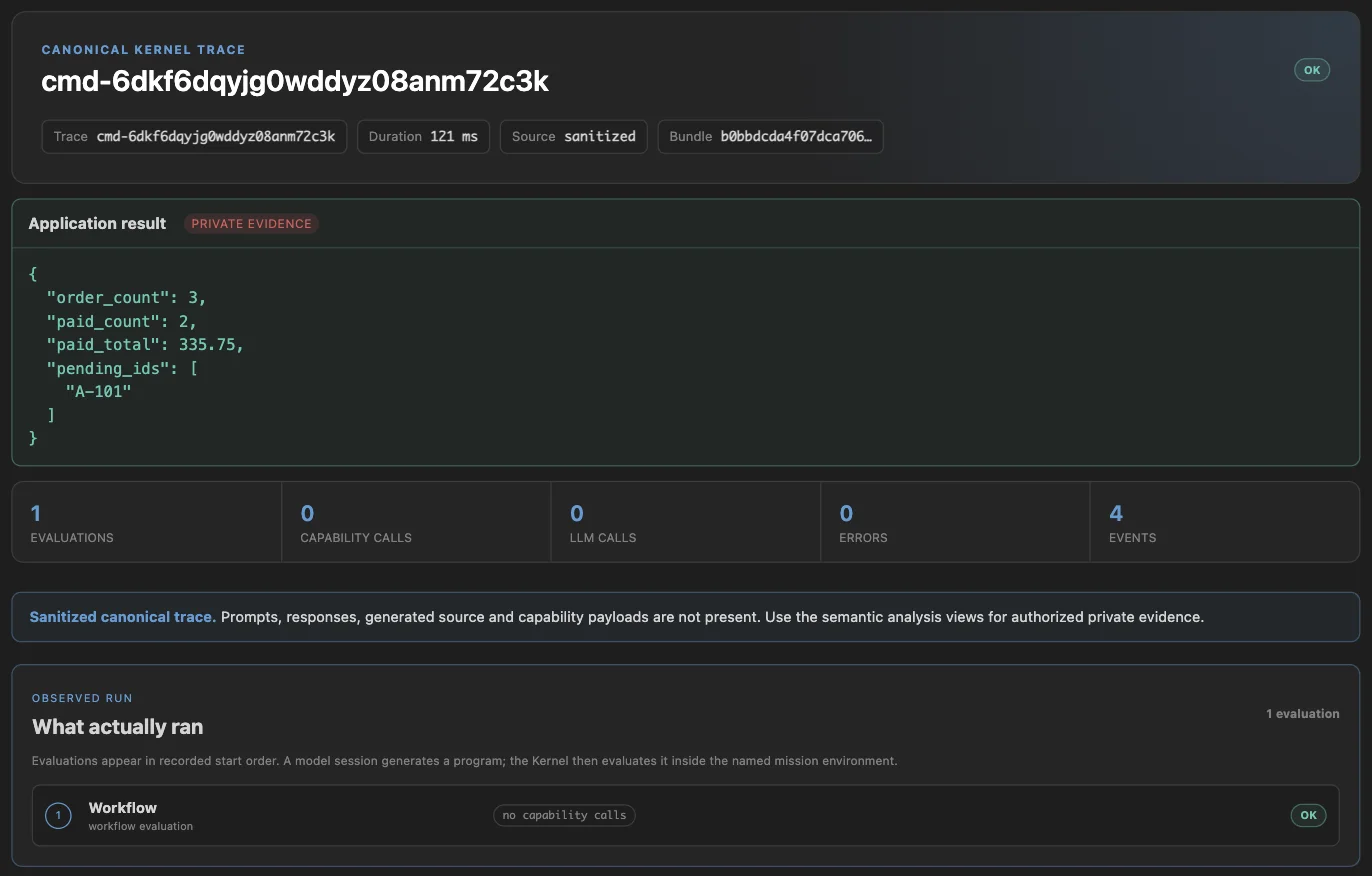
Built on the BEAM
The BEAM is the virtual machine built three decades ago for telephone switches and hardened in production ever since, where huge numbers of concurrent connections, low latency, and failure isolation were the requirements.
Each environment runs in its own BEAM process and gets what an operating system would give a program: preemptive scheduling, so a runaway job cannot starve its neighbours; a per-process heap limit enforced by the VM, so a run over its memory budget is stopped without taking the machine; and let-it-crash isolation, so one failing run never corrupts another. Processes are cheap enough that one machine hosts thousands of runs, with no container per run.
Try it locally
Download the self-contained macOS arm64 archive from GitHub Releases, or pull the Linux Docker image.
0.x, under active development. Breaking changes are expected.
ptc init hello-ptc
ptc run hello-ptc/ptc-project.json

{"greeting":"hello world"}
Runs offline and writes a structured trace.
Build with PtcRunner